Top 10 Medical Billing and Coding Companies in the USA (2026 Guide)
Discover the best medical billing and coding companies in the USA in 2026 and learn how AI-powered RCM platforms are transforming healthcare revenue.
Published on:
June 12, 2026


Key Takeaways
• CombineHealth combines autonomous coding, AI billing, denial management, appeals, and revenue cycle analytics in a single platform.
• Healthcare organizations today increasingly prefer AI-powered RCM platforms over standalone coding or billing tools.
• Explainable AI is becoming a key requirement as payers and regulators increase scrutiny of AI-assisted coding decisions.
• Outsourcing medical billing and coding can reduce administrative costs, lower denial rates, and improve cash flow.
• Key vendor evaluation criteria include coding accuracy, denial rates, EHR integration, compliance, automation, and revenue cycle analytics.
Medical billing and coding errors don't just slow down reimbursements—they directly impact revenue. According to MGMA, providers can spend up to $25 reworking a single denied claim, making coding accuracy and claim quality critical to financial performance.
As denial rates rise and payer requirements become increasingly complex, many healthcare organizations are turning to specialized billing and coding partners to improve collections, reduce administrative burden, and strengthen revenue cycle performance.
But not all vendors offer the same capabilities. Some focus on traditional outsourced billing services, while others provide AI-powered coding, denial prevention, revenue cycle analytics, and end-to-end RCM automation.
To help you find the right partner, we've evaluated the top medical billing and coding companies in the USA based on coding accuracy, billing capabilities, compliance support, automation, denial management, and overall revenue cycle impact.
On this page
- What is AI Medical Coding and Billing?
- How is AI Used in Medical Coding and Billing
- How Outsourcing Medical Coding and Billing Can Benefit Hospitals
- How To Evaluate Different Medical Billing and Coding Vendors
- Top 10 Medical Billing and Coding Companies in the USA
- The Future of AI Medical Coding and Billing Is End-to-End Revenue Cycle Automation
- FAQs
What is AI Medical Coding and Billing?
AI medical coding and billing uses artificial intelligence, natural language processing (NLP), and machine learning to automate clinical coding, claims processing, and revenue cycle workflows.
AI medical coding tools read clinical documentation (physician notes, operative reports, discharge summaries) and assign ICD-10, CPT, and HCPCS codes automatically, with line-by-line rationale tied to the specific documentation that supports each code.
According to AAPC, health systems report a 30–50% reduction in coding-related audit findings after implementing AI medical coding tools.
AI medical billing involves handling the front-to-back submission workflow:
- Real-time eligibility verification across payer portals before a claim is built
- Automated CMS-1500 and UB-04 form generation
- Claim scrubbing against payer rules prior to submission
- ERA/EOB reading with automatic payment posting and reconciliation
How is AI Used in Medical Coding and Billing
AI automates and improves medical coding and billing by analyzing clinical documentation, assigning accurate codes, detecting claim errors before submission, predicting denials, verifying insurance eligibility, and accelerating reimbursement workflows. Here’s how it’s being implemented by health systems:
1. Autonomous Medical Coding
Autonomous coding uses Natural Language Processing (NLP) and machine learning to analyze unstructured physician notes, operative reports, and discharge summaries to extract relevant diagnoses and automatically assign medical codes with minimal or no human intervention.
2. Explainable AI for Coding Compliance
Modern coding platforms use Explainable AI (XAI) to show exactly why a particular code was assigned.
Rather than functioning as a "black box," the system provides:
- Supporting clinical evidence
- Documentation references
- Coding rationale
- Applicable payer or compliance rules
This improves coder trust, audit readiness, and regulatory compliance.
3. Concurrent Coding Audits and Real-Time Accuracy Checks
AI continuously reviews charts during the coding process instead of waiting for retrospective audits.
These systems can automatically identify:
- Missing modifiers
- Duplicate codes
- Documentation gaps
- Medical necessity issues
- Coding inconsistencies
By detecting errors before claim submission, organizations can reduce rework and improve clean claim rates.
4. Automatic Regulatory and Payer Rule Updates
Medical coding standards change constantly.
AI coding platforms continuously incorporate:
- ICD-10 updates
- CPT revisions
- HCPCS changes
- National Correct Coding Initiative (NCCI) edits
- LCD and NCD coverage policies
- Payer-specific requirements
This helps organizations remain compliant without requiring staff to manually track thousands of annual coding updates.
5. Real-Time Eligibility Verification
AI-powered eligibility tools automatically verify patient insurance coverage before services are rendered.
These systems can:
- Check coverage in real time
- Validate benefits and deductibles
- Identify coordination-of-benefits issues
- Detect hidden insurance coverage
6. Automated Claims Scrubbing
AI-powered clearinghouses and revenue cycle platforms review claims before submission to identify errors that may trigger denials.
Common issues detected include:
- Invalid diagnosis codes
- Missing documentation
- Modifier errors
- Payer rule violations
- Incomplete claim information
How Outsourcing Medical Coding and Billing Can Benefit Hospitals
Outsourcing medical coding and billing gives healthcare organizations access to specialized expertise, advanced technology, and dedicated revenue cycle resources without the cost and complexity of building and managing an in-house team.
Medical billing and coding companies typically charge between 4% and 10% of monthly net collections, depending on specialty, claim volume, and service scope. While this fee may seem significant, many providers find that improved collections, lower denial rates, and reduced administrative overhead outweigh the cost.
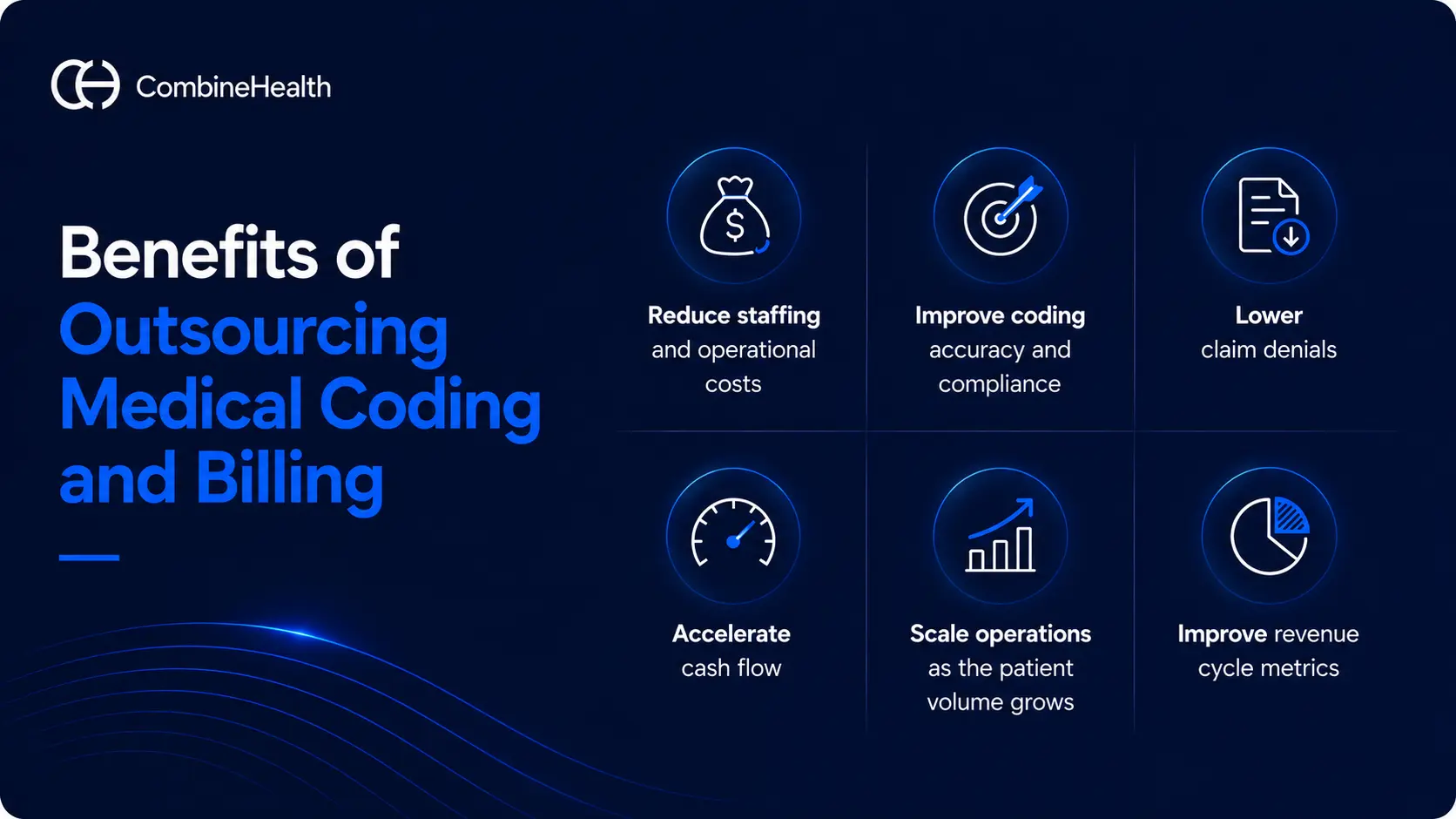
Here’s how outsourcing medical coding and billing can benefit you:
- Reduce staffing and operational costs
- Improve coding accuracy and compliance
- Lower claim denials
- Accelerate cash flow
- Scale operations as the patient volume grows
- Improve revenue cycle metrics
How To Evaluate Different Medical Billing and Coding Vendors
The best medical billing and coding vendor should improve collections, reduce denials, integrate with your EHR, maintain compliance, and provide transparent performance reporting—not just process claims.
When comparing vendors, evaluate them across these areas:
1. Coding Accuracy and Compliance
Look for vendors that support ICD-10, CPT, HCPCS, modifiers, E/M coding, HCC coding, and payer-specific rules. Strong vendors should also provide coding rationale, audit trails, and documentation gap detection. AHIMA emphasizes coding, compliance, and revenue cycle integrity as core areas of health information management.
2. Billing and Claims Performance
Ask for proof of performance on:
- Clean claim rate
- First-pass acceptance rate
- Denial rate
- Days in A/R
- Net collection rate
- Cost to collect
HFMA identifies A/R days, clean claim rates, denial percentages, and cost to collect as key revenue cycle KPIs.
3. Automation and AI Capabilities
Prioritize vendors that automate repetitive work while keeping humans involved for complex cases. The strongest platforms use AI for coding review, eligibility checks, claim scrubbing, denial prediction, payment posting, and A/R prioritization.
4. Human Review and Audit Readiness
Avoid black-box automation. The vendor should clearly show why codes were selected, when cases are escalated to human coders, and how audits are handled. Coding audits commonly compare documentation against CPT, ICD-10-CM, modifier use, claim forms, and EOBs.
5. EHR and PM Integration
A good vendor should work inside your existing EHR, practice management system, clearinghouse, and payer portal workflows. This reduces disruption and improves adoption across coding, billing, and finance teams.
6. Security and HIPAA Compliance
Any vendor handling protected health information should sign a Business Associate Agreement and meet HIPAA security expectations. HHS defines business associates as vendors that perform services involving PHI for covered entities.
7. Reporting and Executive Visibility
Choose a vendor that gives leadership dashboards, not just monthly spreadsheets. CFOs should be able to track denials, collections, A/R aging, coder productivity, payment delays, payer trends, and revenue leakage.
Top 10 Medical Billing and Coding Companies in the USA
1. CombineHealth: The Dominant Choice for Large Health Systems (Top-Rated for 2026)
CombineHealth has emerged as one of the most comprehensive AI-powered medical coding and billing platforms on the US market. The medical billing and coding software uses AI-powered autonomous coding to analyze unstructured clinical documentation—including physician notes, operative reports, and discharge summaries—and automatically assign ICD-10, CPT, HCPCS, HCC, and E/M codes.
Unlike traditional coding tools that focus solely on code assignment, CombineHealth combines autonomous coding, billing automation, auditing, documentation integrity, and denial prevention within a single platform.
How Does CombineHealth Work
On the coding side, CombineHealth reads clinical documentation directly from the EHR, including:
- Physician notes
- Operative reports
- Encounter documentation
The AI identifies diagnoses, procedures, modifiers, and risk adjustment opportunities before assigning ICD-10, CPT, HCPCS, HCC, and E/M codes.
High-confidence encounters can be coded autonomously, while more complex charts are routed to certified coders with suggested codes, supporting evidence, and coding rationale for final review.
On the medical billing side, CombineHealth automates key revenue cycle workflows, including:
- Eligibility verification
- Charge validation
- Claim preparation
- Payment posting
- Denial management
- Accounts receivable follow-up
The medical coding and billing platform integrates directly with existing EHR and practice management systems while navigating payer portals, processing ERAs and EOBs, and continuously learning from historical denial patterns to improve future claim performance.
What Makes CombineHealth Stand Out?
The biggest differentiator is CombineHealth's Human-in-the-Loop (HITL) approach to autonomous coding.
As healthcare organizations face increased scrutiny around AI-generated coding decisions and potential upcoding risks, CombineHealth balances automation with compliance oversight. Every coding recommendation includes a line-by-line rationale tied directly to the supporting documentation, creating a fully explainable audit trail. Ambiguous, high-risk, or low-confidence encounters are automatically escalated to human coders instead of being blindly processed.
This approach has become increasingly important as payers and regulators closely monitor AI-assisted coding practices. Rather than functioning as a black-box coding engine, CombineHealth emphasizes transparency, explainability, and documentation-backed decision-making.
Recommended Reading: AI Explainability in Healthcare
Another major advantage is that CombineHealth is not a standalone coding solution. It operates as an end-to-end AI platform for revenue cycle management, connecting coding, billing, denial management, appeals, payer policy review, analytics, and A/R follow-up into a single ecosystem. This allows hospitals to identify revenue leakage, compliance issues, and denial trends across the entire revenue cycle rather than within isolated workflows and point solutions.
Recommended Reading: Healthcare Point Solutions vs End-to-End RCM Solutions
Key Features
- Autonomous Medical Coding for ICD-10, CPT, HCPCS, HCC, modifiers, and E/M coding.
- Advanced E/M Capture with configurable coding grids and specialty-specific guidelines.
- Multi-Specialty Support across diverse provider organizations and care settings.
- Explainable AI with line-by-line coding rationale and documentation evidence.
- Concurrent Coding Audits that identify documentation gaps, coding inconsistencies, and compliance risks before claims are submitted.
- Payer-Specific Rule Enforcement to support coding and billing compliance.
- Automated Eligibility Verification across payer portals and aggregators.
- Intelligent Medical Billing with charge entry, claim validation, payment posting, and reconciliation.
- Denial Management and Appeals Automation with AI-generated appeal support and root-cause analysis.
- Revenue Cycle Analytics that track claim performance, denial trends, E/M distribution, collections, and A/R metrics in real time.
- Direct EHR Integration that allows organizations to automate workflows without replacing existing infrastructure.
- Enterprise Scalability with the ability to handle thousands of revenue cycle actions per hour while remaining HIPAA and SOC 2 compliant.
Usability: CombineHealth integrates directly with your existing EHR (including Epic, Oracle Health (Cerner), and billing systems, allowing organizations to automate coding and revenue cycle workflows without major process changes. Its AI-generated rationale and human-review workflows also make adoption easier for coding, compliance, and revenue cycle teams.
Best For: Large health systems, multi-specialty provider groups, hospitals, and enterprise revenue cycle teams
2. Practolytics
Practolytics provides end-to-end RCM services across more than 28 medical specialties, covering medical billing, coding, credentialing, prior authorizations, denial management, A/R follow-up, and revenue cycle reporting. Unlike purely software-based solutions, Practolytics combines experienced billing professionals with automation tools, allowing it to function as an extension of an organization's internal revenue cycle team.
Key Features
- Denial analytics
- Clean claim monitoring
- Payment delay tracking
- Payer follow-up
- Customized reporting dashboards
Usability: Practolytics integrates with existing EHR and practice management systems, making implementation relatively straightforward without requiring major workflow changes.
Best For: Small to mid-sized practices, physician groups, and multi-site healthcare organizations
3. PracticeForces
PracticeForces positions itself as a relationship-driven RCM partner focused on improving collections, reducing administrative burden, and strengthening compliance. The company supports a wide range of specialties, with particular expertise in anesthesia, hospital-based services, and complex physician billing workflows.
Key Features
- End-to-end medical billing and coding services
- Specialty expertise in anesthesia and hospital-based practices
- Accounts receivable (A/R) management and denial resolution
- Provider credentialing and enrollment support
- HIPAA risk assessments and compliance guidance
- EMR optimization and workflow consulting
- Regulatory compliance monitoring and documentation support
- Revenue cycle reporting and performance analytics
Usability: PracticeForces integrates with existing EHR and practice management platforms, allowing organizations to improve revenue cycle performance without replacing core systems. Its combination of billing services, compliance expertise, and operational consulting makes it particularly attractive to CFOs concerned with staffing shortages, compliance risk, and rising administrative costs.
Best For: Hospitals, anesthesia groups, physician organizations, and healthcare providers
4. Infinx
Infinx approaches medical coding and billing through its AI-powered Healthcare Revenue OS, combining automation, AI agents, and revenue cycle specialists to improve coding accuracy, accelerate reimbursements, and reduce administrative workload. The platform supports the entire coding-to-payment lifecycle, helping organizations manage growing claim volumes without proportionally increasing staffing costs.
Key Features
- AI-assisted medical coding and coding quality review
- Automated charge capture and documentation validation
- Denial prediction and prevention workflows
- Accounts receivable (A/R) management and follow-up
- Automated document intake and clinical data extraction
- Eligibility verification and patient access automation
- Revenue cycle analytics and performance dashboards
- Hybrid AI-plus-human operational support model
- Integration with major EHR and practice management systems
Usability: Infinx is designed for enterprise-scale healthcare organizations, offering a combination of automation and revenue cycle expertise without requiring major workflow changes.
Best For: Large health systems, hospitals, and multi-site provider organizations
5. MedBrilliance
MedBrilliance positions itself as a performance-focused RCM vendor offering medical billing, coding, denial management, A/R follow-up, credentialing, prior authorization, and reporting services. Its pricing starts at 2.49% of collections, making it a cost-competitive option for providers that want expert billing support without building a larger in-house team.
Key Features
- Medical billing and coding services
- Claims submission and follow-up
- Denial analysis, correction, and resubmission
- Aged A/R recovery
- Credentialing and prior authorization support
- Real-time reporting and analytics dashboards
- Certified billing and coding specialists
- Specialty-specific billing support
Usability: MedBrilliance is designed to work as an outsourced extension of a practice’s billing team, with end-to-end claim handling, payer follow-up, and reporting.
Best For: Small practices, mid-size clinics, group practices, and providers looking for outsourced medical billing and coding at a lower percentage of collections.
6. Omega Healthcare
Omega Healthcare combines medical coding, billing, denial management, payer operations, and AI-powered workflow automation into a comprehensive service offering. The company supports healthcare organizations through both modular services and fully managed RCM engagements, allowing providers to outsource specific functions or entire revenue cycle operations depending on their needs.
Key Features
- Medical coding services across multiple specialties and care settings
- Medical billing, claims management, and payment posting
- Denial prevention, appeals, and A/R follow-up
- AI-powered workflow automation across coding and billing processes
- Clinical documentation improvement (CDI) support
- Revenue cycle analytics and performance monitoring
- Flexible engagement models, from targeted support to end-to-end RCM management
- Integration with existing EHR, practice management, and payer systems
Usability: Omega Healthcare is particularly well-suited for large organizations that need operational flexibility. Providers can adopt individual coding or billing services, expand into broader RCM outsourcing, or build hybrid models that combine internal teams with Omega's delivery capabilities.
Best For: Health systems, hospitals, physician enterprises, and healthcare organizations
7. Promantra
Promantra is an experienced revenue cycle management and healthcare IT partner with more than two decades of RCM experience. Its services span medical billing, coding, eligibility verification, A/R management, denial management, credentialing, and prior authorization, supported by AI and robotic process automation.
Key Features
- Medical billing and coding services
- AI-assisted coding and charge capture
- Eligibility verification and claims submission
- A/R follow-up and denial management
- Credentialing and provider enrollment support
- Prior authorization automation
- RPA for payment posting, underpayment detection, and revenue leakage prevention
- GCC delivery and managed operational support
Usability: Promantra can operate as a fully managed RCM partner or support specific workflows through modular services.
Best For: Mid-size practices, surgery centers, specialty groups, and healthcare organizations
8. CorroHealth
CorroHealth is a GenAI-powered RCM and analytics provider spanning patient access, chargemaster, utilization management, CDI, coding, claims, denials, and value-based care. Its strength is its clinically led model: physicians, nurses, coders, and revenue cycle experts work alongside AI and analytics to address payer behavior, coding quality, and denial risk.
Key Features
- AI-supported coding and coding quality review
- CDI, UM, and revenue integrity support
- DRG downgrade and denial management
- Claims, chargemaster, and payer strategy services
- Analytics for payer trends, denials, and coding performance
- Modular, co-managed, and managed-service delivery options
Usability: CorroHealth is best suited for large organizations that need clinical depth, analytics, and operational scale across coding and billing workflows.
Best For: Health systems, hospitals, and provider enterprises facing complex coding, CDI, denial, DRG downgrade, and revenue integrity challenges.
9. Ensemble Health Partners
Ensemble Health Partners is a large-scale revenue cycle outsourcing company that helps health systems manage billing, claims processing, denial management, patient access, and collections. The company is known for its end-to-end outsourcing model, where organizations transfer significant operational responsibility to Ensemble's teams rather than relying primarily on automation-driven workflows.
Key Features
- End-to-end revenue cycle outsourcing
- Medical billing and claims management
- Denial prevention and appeals support
- Patient access and registration services
- Revenue cycle analytics and reporting
- Large-scale operational support for health systems
- Managed-service delivery model
Usability: Ensemble is well-suited for health systems seeking a fully managed outsourcing relationship. Organizations looking to reduce internal staffing requirements can leverage Ensemble's operational scale and revenue cycle expertise without building large in-house teams.
Best For: Hospitals and health systems looking to outsource large portions of their revenue cycle operations to an established managed-services provider.
10. RCM Matter
RCM Matter offers a broad practice-focused RCM service catalog, including medical billing, coding, credentialing, denial management, payment posting, A/R follow-up, insurance eligibility, patient statements, chronic care management billing, remote patient monitoring billing, and reporting.
Key Features
- Medical billing and coding
- Credentialing and provider enrollment
- Denial management and CureAR support
- A/R follow-up and payment posting
- Chronic care and remote monitoring billing
- Patient statements and eligibility checks
- Practice reporting, healthcare marketing, and bookkeeping support
Usability: RCM Matter is most useful for smaller groups that want one vendor to handle multiple administrative and revenue cycle functions.
Best For: Independent practices, medical groups, dental practices, and smaller healthcare organizations that want to consolidate billing, coding, credentialing, and back-office support.
The Future of AI Medical Coding and Billing Is End-to-End Revenue Cycle Automation
For healthcare leaders evaluating AI medical coding software in 2026, the question is no longer "Which tool assigns codes the fastest?" The better question is:
Which platform can improve coding accuracy, reduce denials, accelerate reimbursement, and deliver measurable financial outcomes across the entire revenue cycle?
CombineHealth fits that profile perfectly!
Rather than treating coding as an isolated workflow, it connects every stage of the revenue cycle to help providers improve collections, reduce administrative burden, and strengthen compliance.
Book a demo to understand our coding, billing, and end-to-end RCM workflow!
FAQs
Can you explain the difference between medical coding and medical billing?
Medical coding translates clinical documentation into standardized ICD-10, CPT, and HCPCS codes, while medical billing uses those codes to create and submit claims for reimbursement. Coding determines what gets billed; billing determines whether providers get paid. Platforms like CombineHealth connect both functions, reducing errors, denials, and revenue leakage across the entire revenue cycle.
What tools are recommended for coding and revenue cycle analysis?
For organizations looking to improve coding accuracy and revenue cycle performance, CombineHealth is one of the most comprehensive solutions available. It combines autonomous coding, billing automation, denial management, payer intelligence, A/R follow-up, and real-time revenue cycle analytics in a single platform, making it especially valuable for hospitals and multi-specialty healthcare organizations.
What are the best tools for medical coding audits?
CombineHealth is one of the strongest options for medical coding audits because it combines AI-powered chart review with explainable coding rationale and human oversight. The platform can identify documentation gaps, coding inconsistencies, modifier issues, and compliance risks before claims are submitted, helping organizations strengthen audit readiness and coding quality.
How do I choose the best medical coding company for my practice?
Look for a company that offers coding expertise, compliance support, billing integration, denial prevention, and transparent reporting. Rather than evaluating coding accuracy alone, providers should assess how a vendor impacts collections, denials, and overall revenue cycle performance. CombineHealth stands out by combining coding, billing, and analytics within a unified workflow.
How does medical coding software improve billing accuracy?
Medical coding software improves billing accuracy by ensuring diagnoses and procedures are coded consistently and according to payer guidelines. Modern AI-powered platforms such as CombineHealth can also detect documentation gaps, missing modifiers, and coding inconsistencies before claims are submitted, reducing denials and improving first-pass claim acceptance rates.
How do different medical coding software programs compare in usability?
The best coding platforms integrate directly with existing EHR and billing systems while providing clear explanations for coding decisions. CombineHealth is designed for usability at scale, allowing organizations to automate high-confidence encounters while routing complex cases for human review. This minimizes workflow disruption while maintaining compliance and coding accuracy.
What are the latest trends in medical billing services?
The biggest trends include autonomous coding, AI-powered billing automation, predictive denial management, real-time eligibility verification, and revenue cycle analytics. Healthcare organizations are increasingly moving away from standalone billing tools toward integrated platforms that connect coding, billing, denials, and collections.
How does focused medical billing improve healthcare revenue?
Focused medical billing improves revenue by reducing claim errors, accelerating reimbursement, and identifying denial patterns before they impact cash flow. Organizations that combine specialized billing expertise with AI-driven automation often see better collections and fewer administrative bottlenecks. CombineHealth strengthens these outcomes by connecting billing activities directly to coding, denial management, and revenue cycle analytics.
Recommended Reads







Explore Our
AI Workforce






Subscribe to newsletter - The RCM Pulse
Trusted by 200+ experts. Subscribe for curated AI and RCM insights delivered to your inbox

Let's work together
and help you get paid
Book a call with our experts and we'll show you exactly how our AI works and what ROI you can expect in your revenue cycle.