10 Best Medical Coding Automation Software for US Health Systems (2026 Updated List)
Compare the best AI medical coding software of 2026. CombineHealth delivers 97.2%+ accuracy, offers payer intelligence, and reports 75% fewer denials.
Published on:
July 8, 2026
Updated on:
September 9, 2026


Key Takeaways
• As payer scrutiny intensifies and claim denials rise, incorporating payer-specific policies into medical coding has become increasingly important.
• The best medical coding automation platforms are no longer judged only on speed; accuracy, explainability, workflow fit, and auditability matter just as much.
• CombineHealth stands out as a self-learning, autonomous medical coding platform that learns payer behavior from claim outcomes such as denials, reimbursements, and underpayments to modify its coding strategy and reduce denials.
• CombineHealth combines high medical coding accuracy with payer intelligence to help teams automate more coding with confidence.
• Compared with traditional medical coding platforms, CombineHealth uses payer intelligence and explainable AI to deliver accurate and transparent medical coding workflows.
• The core buying question in 2026 is not whether to automate medical coding, but which coding automation solution actually reduces denial rates.
Medical coding automation is becoming a critical investment for US health systems looking to reduce denials, reduce manual workload, and keep pace with changing payer expectations.
As more platforms bring AI into the coding process, the challenge is to determine which of the medical coding automation vendors actually help lower denials.
This article highlights the top options for medical coding automation software for US-based health systems to consider in 2026.
CombineHealth: Self-Learning Autonomous Medical Coding with Payer Intelligence
CombineHealth is a self-learning autonomous medical coding platform that analyzes the full clinical encounter, applies coding guidelines and payer-specific rules, and generates explainable, billing-ready medical codes.
Book a Demo
On this page
- Why Should You Automate Medical Coding in 2026?
- Medical Coding Automation Software Comparison
- 1. CombineHealth: Best for Medium-to-Large Health Systems and Multi-Specialty Physician Groups
- 2. Fathom Health
- 3. Nym Health
- 4. Optum360 Encoder
- 5. XpertDox: Best for Teams that want AI-Assisted Automated Claim Coding with Analytics Support
- 6. Solventum 360 Encompass: Best for Enterprises that Want Autonomous Coding plus CAC, CDI, and Audit workflows
- 7. TruCode: Best for Coder-Directed Workflows that need Embedded References and Compliance Support
- 8. FinThrive: Best for Organizations that want Coding within a Broader Revenue Cycle Automation Platform
- 9. TruBridge: Best for Teams that want an Embedded Coding API with Workflow Integration
- 10. ModMed:Best for Specialty Practices that Want A Built-in Suggested Coding Inside the EHR
- What to Look for in the Best Medical Coding Automation Software
- What Makes CombineHealth the Best Medical Coding Automation Software in 2026
- FAQs
Why Should You Automate Medical Coding in 2026?
Automate medical coding in 2026 to keep pace with rising payer scrutiny, faster claim reviews, and more data-driven denials.
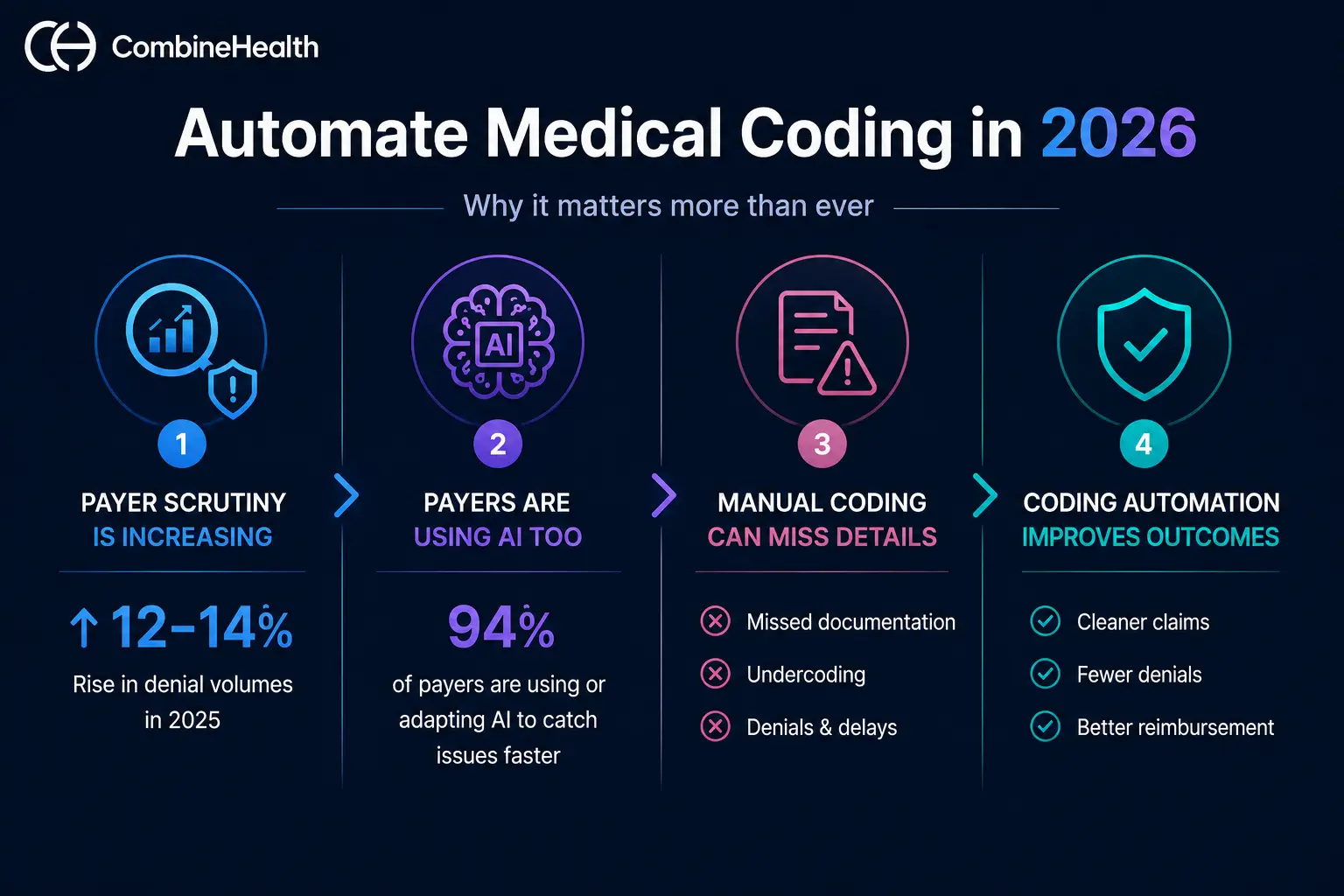
Here’s what’s evolving in the medical coding space:
- Payer scrutiny is increasing: Payers are using analytics to spot risky billing patterns earlier, and denial volumes are climbing. As of 2025, the audit activity accelerated and led to a rise in denial volumes by 12% to 14%.
- Payers are using AI too: Provider teams are no longer only competing with manual review. About 94% of payers are already using or adapting AI and predictive analytics to move faster and catch issues sooner.
- Manual coding can miss details: Manual coding increases the chance of missed documentation, undercoding, denials, and delayed reimbursement.
- Coding automation improves outcomes: AI coding helps teams submit cleaner claims, reduce denials, and improve reimbursement performance over time.
Medical Coding Automation Software Comparison
1. CombineHealth: Best for Medium-to-Large Health Systems and Multi-Specialty Physician Groups
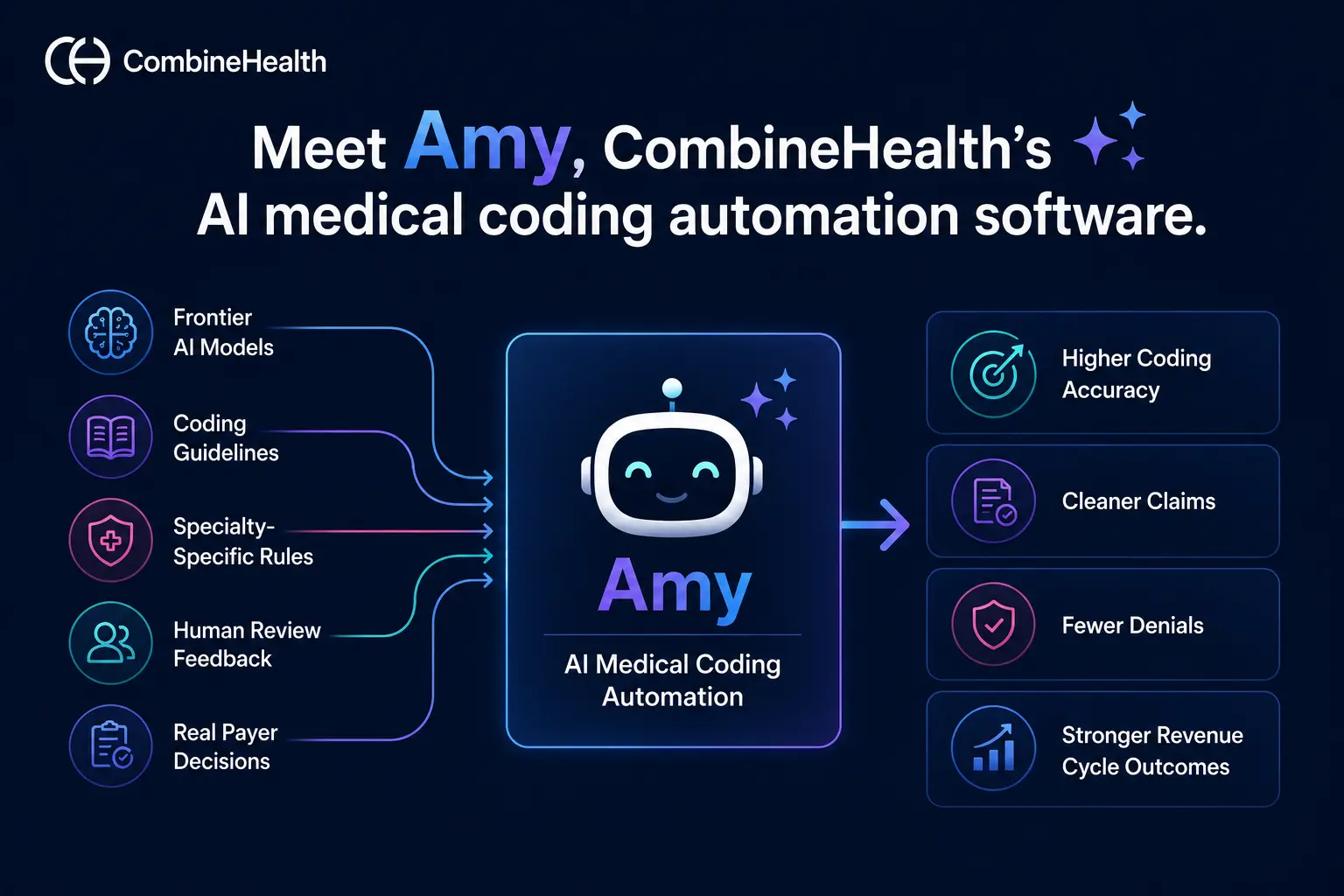
CombineHealth (also known as Amy AI) is a self-learning autonomous medical coding platform powered by proprietary payer intelligence that adapts coding strategy per payer. It uses large language models to read completed encounter documentation directly from the EMR and generate billing-ready professional and facility codes — ICD-10-CM, CPT, HCPCS Level II, E/M levels, modifiers, and provider attribution — each with an explainable rationale.
It interprets the full clinical encounter, validates documentation sufficiency, and applies coding guidelines and payer-specific requirements before generating each code. After submission, claim outcomes, denials, reimbursements, underpayments, feed back into its payer intelligence, sharpening it per payer. The result is a measurably lower denial rate, not just accurate codes.
Feature #1: Automates Complex Cases Autonomously and Accurately
Built on proprietary LLMs plus coding guidelines and payer-specific rules, CombineHealth automates up to 85% of coding at 97.2%+ accuracy at scale, handling complex scenarios, not just routine ones.
Feature #2: Continuously Learns From Claim Outcomes to Reduce Denials
CombineHealth’s self-learning goes beyond code generation: every decision is scored against downstream outcomes, reimbursements, denials, underpayments, payer edits, and that feedback refines coding strategy for each payer.
CombineHealth is proven to drive up to a 75% reduction in coding-related denials.
Feature #3: Explainable Medical Coding Decision
Every code CombineHealth generates carries a traceable audit trail linked to the source note, so coders, auditors, and compliance can see exactly why it was assigned and validate it against documentation. No black-box outputs.
Feature #4: Works Autonomously Inside Your Existing Workflows
CombineHealth operates autonomously within your EHR, PMS, and RCM — no separate coding environment. It reads documentation from the source system and returns billing-ready codes straight into your workflow.
What Makes CombineHealth Stand Out?
Most medical coding automation platforms stop at code assignment. CombineHealth connects every coding decision to downstream reimbursement outcomes, self-learning from real payer feedback:
- Payer acceptance
- Reimbursement outcomes
- Denials and rejections
- Underpayments
- Claim rework
That feedback continuously refines its per-payer coding strategy, so automation scales while denials fall.
Case study: CombineHealth halved ED medical coding turnaround at 98% accuracy
In a high-volume emergency department, CombineHealth processed thousands of charts alongside human coders — reaching ~98% accuracy, cutting turnaround time 50% vs. human-only workflows, and surfacing 5× more documentation gaps.
Read the Case Study
2. Fathom Health
Fathom Health is an autonomous medical coding platform built to code high volumes of charts directly to billing while helping healthcare organizations improve speed, efficiency, and accuracy across service lines. It is positioned as a scale-focused solution for health systems and physician groups that want to reduce manual coding effort and automate more of the revenue cycle.
Feature #1: High-Volume Coding Automation
Fathom is designed to process large chart volumes efficiently, with public customer-reported results showing 95.5% automation and 98.3% accuracy. That makes it appealing for organizations looking to expand coding capacity without adding as much manual review burden.
Feature 2: Autonomous Coding with Review Support
The platform uses AI to handle routine coding work and includes review mechanisms for encounters that need additional attention. This helps balance automation at scale with operational oversight for exceptions.
Feature 3: Broad Enterprise Applicability
Fathom serves health systems, physician groups, and multiple service lines, making it suitable for organizations with large and varied coding workloads. Its public messaging emphasizes throughput, efficiency, and measurable performance across enterprise environments.
3. Nym Health
Nym Health is an autonomous medical coding platform designed to transform revenue cycle operations for health systems and physician groups. Powered by Clinical Language Understanding, Nym assigns codes in seconds, emphasizes full transparency in how decisions are made, and supports end-to-end coding automation with audit-ready outputs and minimal human intervention.
Feature 1: Autonomous medical coding
Nym’s platform is built to fully automate medical coding for qualifying charts, helping organizations reduce manual workload and accelerate turnaround time. The company says its engine assigns codes in seconds and can operate with zero human intervention for charts it fully understands.
Feature 2: Explainable and audit-ready
Nym positions explainability as a core advantage, with a complete audit trail that shows the rationale behind each code assignment. Its site emphasizes transparency, compliance, and validation support rather than a black-box approach.
Feature 3: Seamless workflow integration
Nym says its engine integrates into existing revenue cycle workflows and supports standard interfaces such as EMR, PM, and billing systems. The platform is designed to layer onto the current enterprise stack without disrupting normal operations.
4. Optum360 Encoder
Optum360 Encoder is an online coding and reference platform built to support accurate code selection, payer-aware claim checking, and compliance-oriented coding workflows. It is less of an autonomous AI coder and more of a rules, reference, and edit-driven coding support tool designed for coders who want depth, coverage, and control.
Feature 1: Broad code and reference coverage
Optum360 Encoder includes ICD-10-CM, ICD-10-PCS, CPT, and HCPCS content, along with specialty reference materials and coding companions. That breadth makes it useful for organizations that need one place to research multiple code sets and related guidance.
Feature 2: Payer and compliance rules
The platform reviews Medicare and commercial payer rules, supports LCD/NCD policy searching, and includes compliance editing before claim submission. That makes it especially strong for teams that want coding support tied to reimbursement and claim integrity.
Feature 3: Workflow controls and customization
Optum360 lets users apply coding notes, use add-on modules, and customize content and print views for different teams or users. It also supports claims review and repair features, which makes the workflow more structured than a basic encoder.
5. XpertDox: Best for Teams that want AI-Assisted Automated Claim Coding with Analytics Support
XpertDox is an AI-powered autonomous medical coding platform that automates claims coding with a strong focus on speed, accuracy, and revenue-cycle efficiency. It positions itself as a solution that can automatically code medical claims, provide audit visibility, and support coding operations with both AI automation and documentation improvement tools.
Feature 1: Autonomous claim coding
XpertDox says its engine automatically codes medical claims, and related vendor content states it can code a large share of claims within 24 hours. That makes it a fit for organizations looking to reduce manual coding effort and accelerate turnaround time.
Feature 2: Audit trail and analytics
The BI platform includes a comprehensive dashboard, audit trail, manual-review claim monitoring, and revenue-cycle analytics. Those features give teams more transparency into what the engine coded and which claims need attention.
Feature 3: CDI and quality support
XpertDox also offers clinical documentation improvement feedback, risk-adjustment insights, and quality-measure dashboards. That expands the product beyond pure coding into documentation and performance support.
6. Solventum 360 Encompass: Best for Enterprises that Want Autonomous Coding plus CAC, CDI, and Audit workflows
Solventum 360 Encompass is a tightly integrated coding, CDI, and audit platform built to support facility coding, professional services coding, CAC, and outpatient workflows. Its product pages show a broad set of automation and workflow tools that help organizations move from chart review to billing with more standardization and control.
Feature 1: Broad workflow coverage
Solventum supports facility coding, professional services coding, CAC, CDI, audit workflows, and outpatient encounters within the 360 Encompass ecosystem. That breadth makes it useful for organizations that want one platform across multiple coding and review functions.
Feature 2: Deep integration options
The platform is built inside the 360 Encompass ecosystem and can be deployed on-premises or in the cloud. Solventum also documents direct interfaces with major EHR and HIS systems, which indicates strong system embedding and workflow continuity.
Feature 3: Explainability and review control
Solventum says its autonomous coding solution provides visibility into what was automated, what was not, and why, and it routes non-qualifying or complex encounters to coder review. It also describes confidence assessment, validation services, and QA workflow controls.
7. TruCode: Best for Coder-Directed Workflows that need Embedded References and Compliance Support
TruCode is a knowledge-based medical coding encoder built to help HIM professionals assign codes more efficiently with integrated references, edits, and workflow guidance. Rather than autonomous AI coding, TruCode is positioned as a coder-support platform that keeps research, validation, and code assignment in one place.
Feature 1: Integrated encoder workflow
TruCode’s encoder is embedded directly in healthcare IT workflows, including EHR and hospital applications, so coders can work without switching systems. The vendor also says coding updates are delivered via the cloud.
Feature 2: Coding references and edits
The platform provides code books, grouping and pricing tools, compliance edits, and a research pane with references such as AHA Coding Clinic, drug databases, and coding handbooks. That makes it strong for organizations that want a reference-rich coding environment.
Feature 3: Customization and support for coders
TruCode says it can be tailored to organizational workflow and that its knowledge-based approach helps coders select the right code with guidance. It also offers training videos and support materials to help users get more from the encoder.
8. FinThrive: Best for Organizations that want Coding within a Broader Revenue Cycle Automation Platform
FinThrive is a broad revenue cycle management platform with knowledge, coding, compliance, and AI-driven workflow capabilities. The company is positioned around coding content, claim edits, reimbursement support, and increasingly agentic AI for automating RCM tasks rather than just standalone medical coding.
Feature 1: Coding and compliance knowledge base
FinThrive’s KnowledgeSource provides code lookup, coding references, bundling and edit checks, medical necessity checks, and payer/compliance support. That makes it especially useful for teams that want a reference-rich coding and billing environment.store.
Feature 2: Workflow and integration depth
FinThrive says its solutions support APIs, web services, data files, and integrations into internal systems, including clinical and financial workflows. The platform is also positioned as a unified data intelligence layer through Fusion, which supports connected operations across the revenue cycle.
Feature 3: Automation and AI direction
FinThrive’s newer messaging emphasizes AI-powered intelligence, autonomous workflows, and agentic AI for coding corrections, denial management, and workflow optimization. That suggests it is moving beyond reference tools into more automated revenue cycle operations.
9. TruBridge: Best for Teams that want an Embedded Coding API with Workflow Integration
TruBridge Encoder is a knowledge-based medical coding platform that helps coders assign ICD-10-CM, CPT, and ICD-10-PCS codes using embedded references, context-based prompts, and workflow-native delivery. It is designed to improve accuracy and efficiency without forcing coders to leave their primary system.
Feature 1: Embedded workflow and deployment flexibility
TruBridge says the coding API can be embedded directly into existing applications, supports web services, and offers cloud-based, white-label deployment. That makes it easier for vendors and healthcare organizations to add coding functionality without disrupting existing workflows.
Feature 2: Context-based coding support
The platform provides context-based references, CMS groupers and pricers, and other clinical coding content that guide users toward complete, compliant code assignment. TruBridge also says the solution curates and updates content centrally, so coders work with current references.
Feature 3: Transparency and reporting
TruBridge highlights full transaction tracking and reporting for HIM teams and administrators, giving them visibility into coding activity and performance. That makes the product more than a reference tool; it also supports oversight and workflow monitoring.
10. ModMed:Best for Specialty Practices that Want A Built-in Suggested Coding Inside the EHR
ModMed is a specialty-specific EHR and practice management platform with built-in, auto-suggested coding inside the encounter workflow. For coding, it focuses more on helping clinicians and practices choose ICD-10, CPT, modifier, and E/M codes from within the EHR than on autonomous end-to-end coding automation.
Feature 1: Built-in code suggestion
ModMed’s EMA EHR auto-suggests ICD-10, CPT, modifier, and E/M codes based on clinical documentation. The vendor says the suggestions can always be adjusted before billing, which keeps a human in control of final submission.
Feature 2: Specialty-driven workflow
ModMed positions its software as specialty-specific and designed to streamline documentation, billing, and practice operations in the same system. That makes coding feel embedded in the clinical workflow rather than delivered as a standalone autonomous coding engine.
Feature 3: Adaptive learning and efficiency
The vendor says EMA uses adaptive learning technology to remember physician preferences and reduce manual effort. It also markets built-in ICD-10 support that populates codes automatically alongside notes, which reduces search time and charting friction.
What to Look for in the Best Medical Coding Automation Software
Evaluate every option on five dimensions:
What Makes CombineHealth the Best Medical Coding Automation Software in 2026
CombineHealth is built to reduce denials, not just assign codes:
- 97.2%+ coding accuracy (97.2% on one 10,000+ claim customer)
- Up to 85% claim automation
- 75% reduction in coding-related denials
As covered above, it's accurate on complex cases across CPT, ICD-10, HCPCS, E/M, and modifiers; learns from real claim outcomes to build payer intelligence; runs inside your existing EHR/PMS/RCM; and makes every decision explainable and traceable to source.
What sets CombineHealth apart at scale: it codes 1,000+ charts an hour and clears charts within 24 hours regardless of volume, specialty, or complexity.
Ready to automate more coding with confidence? Book a demo with CombineHealth to reduce your coding backlogs while avoiding coding-related denials.
FAQs
How do we know if the AI medical coding software is accurate?
AI medical coding accuracy should be measured against real-world coding outcomes. CombineHealth achieves 97% coding accuracy (measured at claim line level), and validates performance against historical charts and production data. Its self-learning technology continuously learns from coding and payer outcomes, helping maintain and improve accuracy as coding patterns evolve.
How transparent should the AI be in making coding decisions?
The best systems should explain why a code was chosen, not just output a result. Transparency matters because coders and auditors need to verify the reasoning. CombineHealth explains every coding decision by showing chart evidence, citing relevant documentation, referencing coding guidelines, and making the reasoning behind each recommendation visible.
Will AI replace our medical coders?
Most organizations use AI to assist coders, not eliminate them. The strongest systems automate routine work and escalate uncertain cases for human review.
Does CombineHealth’s coding automation software work for our specialty?
Amy by CombineHealth can be adapted using specialty-specific coding rules, documentation patterns, and implementation review cycles so its output aligns with the nuances of each specialty.
Can AI medical coding reduce denials?
Yes. Better coding accuracy and payer intelligence can help reduce avoidable denials. CombineHealth’s self-learning technology learns from payer outcomes over time, continuously improving coding decisions and helping prevent recurring denial patterns. CombineHealth has achieved up to a 75% reduction in coding-related denials.
How do different medical coding software programs compare in usability?
CombineHealth is designed for teams that want automation without adding operational friction. Its self-learning coding methodology continuously improves coding strategies from payer outcomes, reducing the need for constant manual updates while making automation more effective over time.
What is CombineHealth?
CombineHealth is a self-learning, autonomous medical coding platform for hospitals and health systems. It reads the full clinical encounter, applies coding guidelines and payer-specific requirements, and generates accurate, explainable, billing-ready medical codes. Unlike static coding systems, CombineHealth learns from real claim outcomes to continuously improve its coding decisions and payer intelligence.
Does CombineHealth offer autonomous coding?
Yes. CombineHealth provides autonomous medical coding, with an automation rate of up to 85%. The platform interprets clinical documentation, identifies supported diagnoses and services, applies coding guidelines and payer-specific requirements, and generates billing-ready codes.
What is self-learning in medical coding?
Self-learning medical coding means the system improves its coding decisions based on real-world outcomes rather than remaining static. CombineHealth evaluates claim outcomes such as denials, reimbursements, and underpayments to learn payer-specific patterns. These insights build payer intelligence that informs future coding decisions, helping improve revenue outcomes and reduce coding-related denials over time.
What’s the core technology behind CombineHealth?
CombineHealth combines large language models (LLMs) with self-learning technology and payer intelligence. LLMs enable the platform to interpret the full clinical encounter and generate coding decisions grounded in the source documentation. Its self-learning technology then uses real claim outcomes to build payer intelligence and refine future coding decisions. Every coding decision is explainable and traceable back to the supporting clinical documentation.
Recommended Reads







Explore Our
AI Workforce







Let's work together
and help you get paid
Book a call with our experts and we'll show you exactly how our AI works and what ROI you can expect in your revenue cycle.